%20(1).svg)
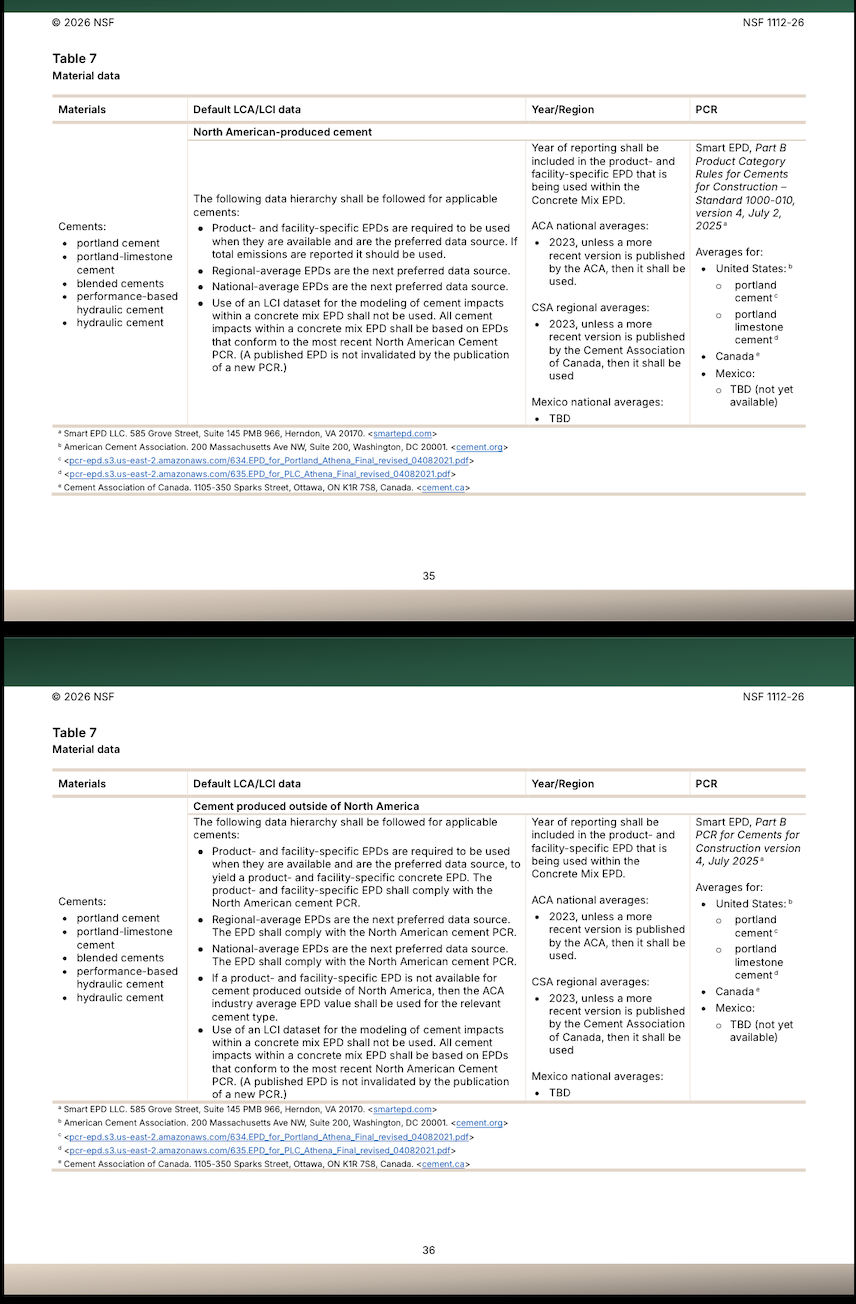
Concrete EPDs produced for the North American market are built under a Product Category Rule (PCR) that specifically requires ISO 21930 as the underlying accounting framework. Because of that, any cement EPD used as an input also needs to comply with the North American cement PCR — a product-specific EPD built on the European EN 15804 framework can't be substituted in directly, even if it's a real, valid EPD in its own right.
How this worksEN 15804 and ISO 21930 are both legitimate, widely used standards for building-product EPDs, but they're not interchangeable — they define system boundaries, allocation rules, and impact calculations differently, in ways that produce genuinely different results for the same physical product. Combining data built under one framework into an EPD built under the other would misrepresent the underlying calculation, not just present it differently.
That's why the North American ready-mix concrete PCR (NSF 1112-26) sets out a defined hierarchy for cement data: a product- and facility-specific EPD is preferred, but it must comply with the North American cement PCR, regardless of where the cement itself was actually produced. Regional-average and national-average EPDs follow the same requirement. Generic LCI datasets are not permitted as a substitute — cement impacts always need to be based on an EPD that conforms to the current North American cement PCR.
Troubleshooting
You can reach Customer Support directly here: Submit a Support Ticket